

The Connected Building Revolution
Modern buildings depend on more than heating, ventilation and air conditioning equipment. Today’s facilities integrate HVAC, lighting, access control, energy monitoring and fire systems into a single Building Management System (BMS).
This level of integration delivers significant benefits. Facility managers gain better visibility, tighter control and improved operational efficiency. They can also respond more quickly to faults and changing building requirements.
However, greater connectivity introduces new risks. Every controller, sensor and gateway creates another potential entry point for a cyberattack. Building automation networks now connect to enterprise systems, cloud services and remote maintenance platforms.
Consequently, cybersecurity has become a critical consideration for building owners, consulting engineers and system integrators. Security can no longer be treated as an optional feature. Instead, it must form part of the overall design strategy.
As smart buildings evolve, cyber resilience becomes as important as physical security. Organisations that ignore cyber risks expose themselves to operational disruption, financial loss and reputational damage.
Why BMS Networks Are Targets
Cybercriminals increasingly target operational technology environments. In the past, attackers focused primarily on corporate IT networks. Today, building systems present another valuable opportunity.
A cyberattack on a building management system can disrupt critical functions. Attackers may alter HVAC schedules, disable alarms or interfere with environmental controls. These actions can affect occupant comfort, productivity and safety.
Furthermore, many facilities depend on continuous operation. Hospitals, data centres and manufacturing plants often require stable environmental conditions. Even a short disruption can create serious operational challenges.
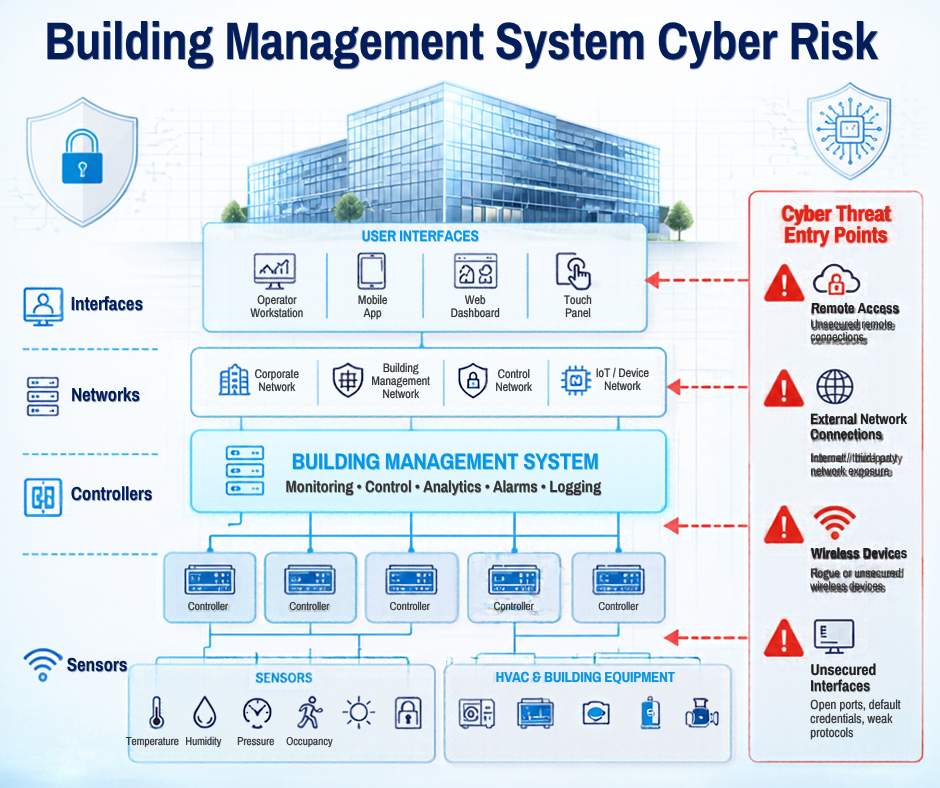
Remote access also increases exposure. Facility managers often use remote access to monitor performance and install updates. While remote connectivity improves efficiency, it creates additional attack pathways when organisations fail to implement proper controls.
Therefore, organisations must view cybersecurity as an operational priority. A secure building depends on secure digital infrastructure.
Risks in Connected HVAC Systems
Modern buildings contain large numbers of connected devices. Sensors, actuators, controllers and drives exchange information continuously across the network.
Many of these devices prioritised reliability over cybersecurity. As a result, older installations may still contain default passwords, outdated firmware and unencrypted communications.
In addition, building automation equipment often remains in service for many years. These extended lifecycles can allow vulnerabilities to persist for long periods. Consequently, proactive maintenance becomes essential.
Another challenge involves system diversity. A single building may contain equipment from many manufacturers and product generations. Integrating these technologies can complicate security management.
Moreover, attackers often target the weakest point in the network. A poorly configured field device can provide access to larger systems and critical infrastructure.
For this reason, organisations must treat every connected device as part of their cybersecurity strategy.
Securing BACnet/IP Networks
BACnet remains one of the most widely used protocols in building automation. Its open architecture supports interoperability between different devices and manufacturers.
However, traditional BACnet/IP communications were not designed to address modern cyber threats. Organisations may increase risk when they expose building networks directly to external access.
Therefore, network architecture plays a vital role in system security. Network segmentation limits movement between operational technology and business systems during an attack. This approach reduces the likelihood of widespread disruption.
Strong firewall policies provide another important layer of protection. Administrators should restrict communications to authorised devices and approved services.
Likewise, organisations should use virtual private networks for remote access. VPNs deliver stronger protection than publicly exposed connections.
Secure communications protect data integrity and reduce interception risks. As a result, encryption continues to play an increasingly important role in building automation systems.
Industry developments such as BACnet Secure Connect also support more resilient building automation architectures. These technologies help align building systems with modern cybersecurity expectations.
Edge Controllers and Cybersecurity
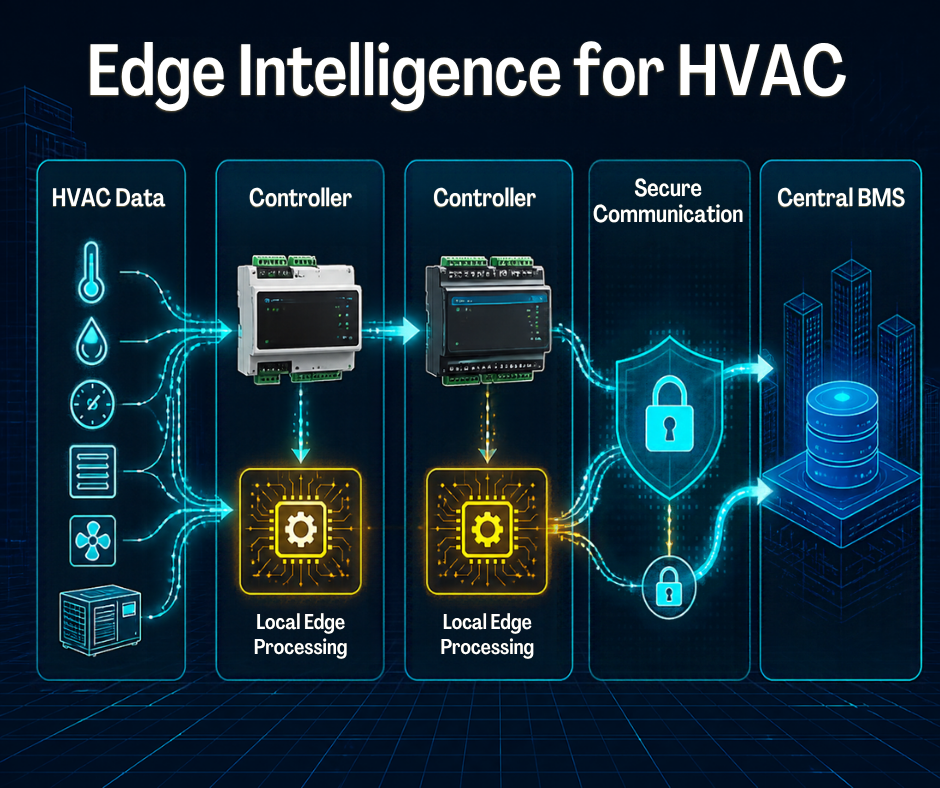
Edge intelligence is reshaping building automation. Instead of sending all data to a central platform, modern controllers can process information locally.
This approach improves responsiveness and reduces network traffic. It also enhances operational resilience by decreasing dependence on centralised processing.
Importantly, edge controllers can strengthen cybersecurity strategies. Local decision-making reduces the need for constant communication across external networks. Consequently, critical building functions can continue during network disruptions.
Many modern edge devices include advanced security features. Examples include encrypted communications, certificate-based authentication and secure firmware management.
Nevertheless, edge intelligence does not eliminate cybersecurity risks. Organisations still require robust policies, effective access control and regular software updates.
When implemented correctly, edge architectures support both operational efficiency and stronger cyber resilience.
Cybersecurity Best Practice
Effective cybersecurity requires a structured approach. Technology alone cannot guarantee security.
First, organisations should eliminate default passwords and enforce strong authentication policies. Good credential management remains one of the most effective security measures available.
Second, facility teams should maintain accurate asset inventories. You cannot protect devices that remain unknown. Comprehensive visibility improves risk management and vulnerability assessment.
Third, administrators should install validated software and firmware updates. Regular patching reduces exposure to known vulnerabilities and security flaws.
Furthermore, organisations should apply the principle of least privilege. Users should only receive access necessary for their specific responsibilities.
Continuous monitoring helps teams detect problems before they escalate. Early detection allows faster investigation and response.
Finally, staff training remains essential. Human error continues to contribute to cybersecurity incidents across many industries.
Together, these measures create a more secure operational environment.
Training and Lifecycle Security
Cybersecurity is not a one-time project. It requires ongoing attention throughout the lifecycle of a building automation system.
As technologies evolve, new vulnerabilities emerge. Therefore, organisations must review security policies, user permissions and network configurations regularly.
Training programmes help engineers understand current threats and mitigation strategies. They also promote consistent application of cybersecurity best practice.
Regular audits provide additional value. These reviews can identify outdated software, unused accounts and configuration weaknesses before attackers exploit them.
Lifecycle planning also supports long-term security. Manufacturers eventually stop supporting older equipment. When devices no longer receive updates, replacement may become the best option.
Consequently, organisations should incorporate cybersecurity into their upgrade strategies and capital planning processes.
A lifecycle approach strengthens security and improves operational reliability.
Building Security for the Future
Building automation will continue to become more intelligent, connected and data driven. Artificial intelligence, advanced analytics and edge computing will deliver significant operational benefits.
At the same time, cyber threats will continue to evolve. Attackers increasingly target operational technology because of its strategic importance.
Consequently, cybersecurity must become a core design principle. Future buildings will depend on secure communications, authenticated devices and resilient network architectures.
Success requires collaboration across the industry. Manufacturers, consultants, system integrators, facility managers and building owners all play important roles.
Moreover, cybersecurity must support every project stage. Security should influence design, deployment, operation and maintenance decisions.
The buildings of tomorrow will not simply be smart. They must also be secure.
By embedding cybersecurity into every phase of building automation, organisations can protect critical assets while unlocking the full value of intelligent building technologies.
Automated Control Solutions supplies a range of field devices and building management software as well as peripheral equipment to keep your HVAC and building projects on track. Contact us today to see how we can assist.